Caves and tunnels
General Information
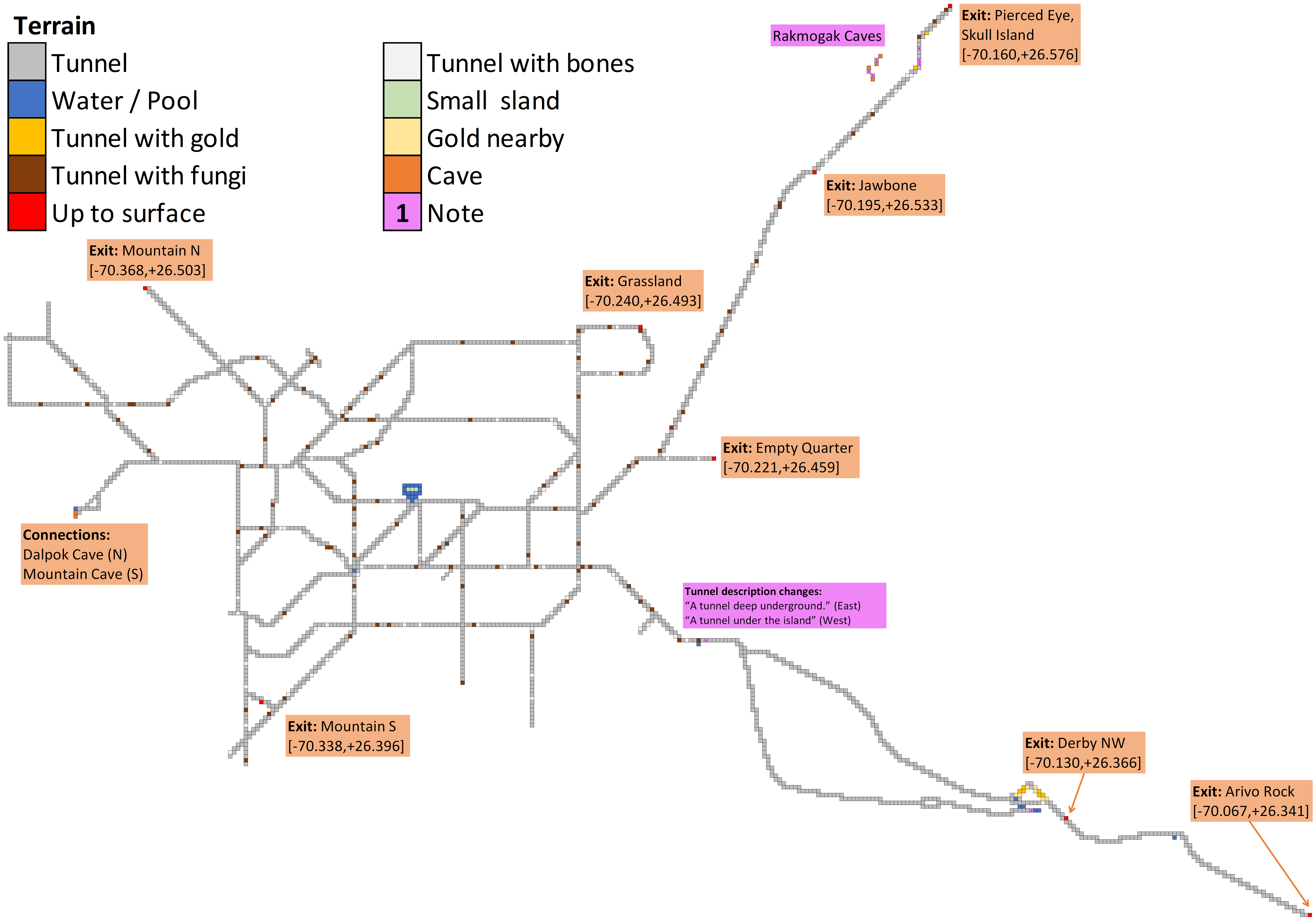
A large tunnel network inhabited by rats and giant spiders connects many places of Shartak. It can be entered and exited through a number of caves scattered around the archipelago. Other animals can sometimes be spotted in the tunnels, as they can wander in from the jungle and get lost.
Caves
 |
A number of caves have been found on Shartak since the rediscovery of the forbidden village of Rakmogak on 13th August 2008. These caves connect the mountain, Dalpok and various other locations through a vast network of tunnels that extends beneath the archipelago. The locations of the caves are as follows:
| Cave | GPS Coordinates | Ubermap Zoom |
| Dalpok Cave | [-70.429,+26.449] | [1] |
| Mountain Cave | [-70.366,+26.443] | [2] |
| Grassland Cave | [-70.240,+26.493] | [3] |
| Arivo Rock Cave | [-70.067,+26.341] | [4] |
| Empty Quarter Cave | [-70.221,+26.459] | [5] |
| Cave North of the Mountain | [-70.368,+26.503] | [6] |
| Jawbone Cave (SW of Rakmogak) | [-70.195,+26.533] | [7] |
| Pierced Eye Cave (NE of Rakmogak) | [-70.160,+26.576] | [8] |
| Cave South of the Mountain | [-70.338,+26.396] | [9] |
| Cave Northwest of Derby | [-70.130,+26.366] | [10] |
Tunnel Network

The tunnel network consists of tunnel tiles surrounded by impassable solid rock. While the tunnels look the same, they can have different descriptions. Of particular note are the fungi farms where fungi can be found. There are also several water tiles that provide fresh water. In addition to the various cave entrances listed above, the main tunnel network connects to the mountain tunnel and the Dalpok tunnel in the west through a cave-in that has been cleared. These smaller caves are detailed in their respective articles. There are also two small caves in Rakmogak visible on the map, but they do not connect to the rest of the tunnel network and never seem to contain rats or giant spiders.
Notes
Noted on the map with a pink color are a few tunnel tiles with different descriptions. They are as follows, matching the numbers marked on the map:
1) As marked on the map, this is the first tile where the description changes to "A tunnel deep underground.” when moving east towards Derby. Elsewhere the default tunnel description is "A tunnel under the island."
2) The tunnel tile in front of the dead end filled with water has the following description: "The tunnel slopes downwards at an alarming rate, but it's not long before you can't go any further due to the way being blocked by water."
3) These tunnel tiles have the following description: "The tunnel slopes at an alarming angle. Loose earth and stones make the rock floor slippery underfoot."
4) This tunnel tile has the following description: "The tunnel narrows to a vertical crack, beyond which there is only blackness. The walls press close as scratching noises issue from the shadows above. Earth rains down continuously." This is the same description as the tunnels by some cave entrances, so this might be a bug, as there is no entrance here.
5) The tunnels in the Rakmogak caves have the following description: "Tucked away under a mound, this tunnel connects the two caves."
History
Before Rakmogak was introduced, the smaller tunnels near Dalpok and on the mountain used to be the only caves and tunnels that existed in Shartak. After its addition, the entire main tunnel network was initially crawling with rats and giant spiders, making the efforts to map it very difficult and time-consuming. Even then, some early maps were produced within the first few months of the discovery. One of the earlier full maps by an unknown author is available [here]. The south-eastern branch of the tunnels leading to the rocky islet southeast of Derby, now known as Arivo Rock, is believed to have appeared slightly later than the rest of the tunnels. The islet was first discovered through the tunnel network by Raivo, who participated in the early exploration efforts among with many others, and also produced the most recent and detailed map of the tunnel network.